National Motorcycle Museum's "Try a Classic" day.
Neville Pugh, Wednesday, 15 April 2026
As a recent new "Friend of the Museum" at the National Motorcycle Museum in Solihull (£35 for the year), as well as free access to all their exhibits you get a quarterly newsletter which includes a list of all their forthcoming events. This includes the likes of workshop days, classic riding days, and the opportunity to sign up for one of their quarterly "Try a Classic" events.
These are held at the museum itself, and allow you to spend a couple of hours pottering round on a short circuit crafted out of an area of their large car park on a selection of a dozen or so bikes from the museum itself. In the traditional "I'll have me a slice of that !" I signed up for the event on Saturday 11th April, for the afternoon session (now I'm retired, early mornings are something I avoid !)
Arriving on site I was greeted in the car park by several hundred cars and bikes, and a veritable swarm of people - after a short while it dawned on me that this was also the day of "The Motorcycle Show Ride-In 2026", and a large quantity of people (plus trade and food stands) had turned up for the chance to see Henry Cole and friends. Before you ask, no, sadly I missed seeing Alan Millyard. This flood of humankind descending on the museum made finding where to sign up for the Try a Classic event ("the what mate ?") somewhat of a challenge, but I duly did find it, and completed the documentation and handed over my £25 for "insurance" and wombled out to our corner of the carpark where I was greeted by 14 bikes.
Now, sadly, a beautiful Triumph 3T and a flat-tank Royal Enfield had died on the (apparently very rainy) morning session, and these were wheeled to one side - tempting to look at, but unavailable to try.
The rest of the group consisted of a varied collection starting with a 1914 "The New Comet" and finishing with some random naked 2004 Triumph which I had the suspicion had been hastily wheeled out to fill a 3T-shaped gap - not many people in our group rode that to be honest. And in between you had a nicely varied selection of mainly 1950's and 1960's Triumphs, Ariels and BSAs.
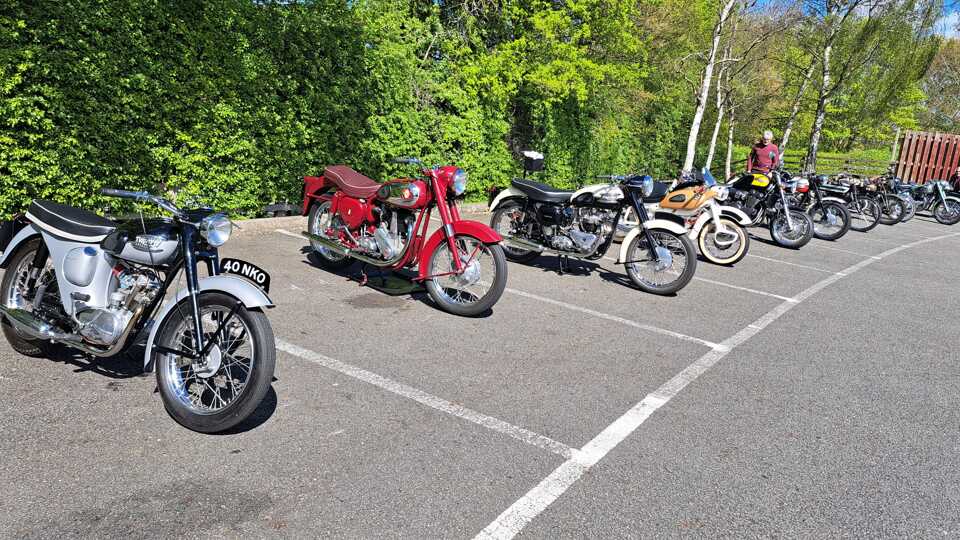
I will say at this point, this was my only fault with the day - knowing what I was riding (further beyond the name on the tank). Apparently they normally put the signs out from the museum relevant to each bike, but with the morning's rain and our afternoon wind, they'd taken the decision to leave those indoors. Those of you reading this who are more wise and knowing than I (or potentially, more old) may have a better idea on some of the bikes model numbers, so you'll have to forgive my dullardness where ommitted.
Thirteen paying customers slowly turned up, and I got chatting to many of them - quite a few people I spoke to had come previously to one of these events, some of them multiple times a year. Apparently within the bike selections there's always some regulars, with a smattering of something different each time. There were supposed to be 14 of us, but someone was persona-non-grata; possibly caught up in the star-struck Henry Cole show going off elsewhere on site. This meant (if we ignore the 2004 bike) 11 bikes for 13 people (after another drop out), which as I will explain shortly wasn't actually a problem.
One of the volunteers performed a briefing which was, mercifully, brief. There was probably the same number of volunteers around to help as there were "paying punters" which worked out great - some of these were dotted around the course in case of incident (which I'm happy to say, I didn't see any of) and the rest were manning the "pitstop" area where bikes were handed over to the next willing rider - handovers which frequently resulted in stalls or temperamentality, which the volunteers were on hand to (usually) quickly sort. They also had one of those petrol-engined machines used on race circuits to start bikes by applying a small wheel to the bike's rear wheel, and spinning it vigorously. They'd let us wear ourselves out first by trying manfully to manually kick start the bikes 5 or 6 times (some of those compression ratios where HIGH !) and then step in with the pit starter to show how someone who knew what they were doing would start a bike.
First though, we were walked around the course, which was laid out in a roughly M shaped course using traffic cones and tape. Traffic cones and tape being what traffic cones and tape are, this led to a number of impromptu course redesigns during the afternoon thanks to the aforementioned wind, which took delight in remodelling things on more than one occasion. Frequently just as you were passing said wind-blown cone ...
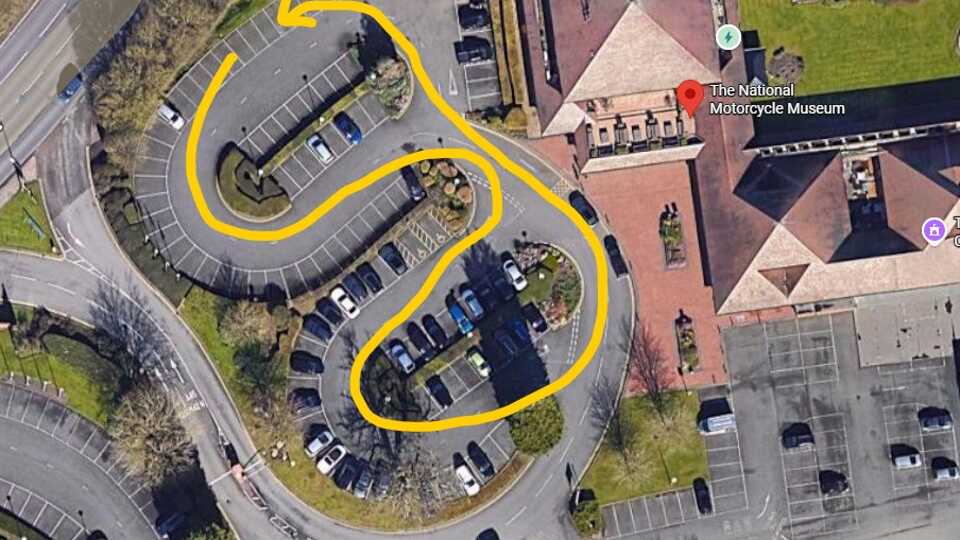
Whilst walking the course I caught sight of fellow CWAM Observer Steve Krikler who was walking in (presumably to get his dose of Henry) - calling out to Steve redirected him in my direction, meaning I missed the second half of the briefing (my fault !) but it didn't seem to matter. Steve decided to hang around and observe the fun, and quite kindly takes credit for a number of the photos - thanks Steve !
And then we were off. The format was simple - pick a bike, go off and do 5 or 6 laps (as you saw fit, they weren't prescriptive about it), come in and hand over to the next person waiting. This actually worked really well, and whilst there were a couple more people than bikes, you were rarely waiting more than a minute or so before you could get on something. The atmosphere was all very friendly too - whilst the NMM volunteers helped aplenty, it was often the person getting off the bike who would show you the ropes, tell you of any oddities or foibles ("needs LOTS of revs mate !") and most important of all, tell you where the heck was first gear ! For some bikes it was the traditional 1-down (albeit on every bike the gearshift was on the right) but the majority were 1-up. Most bikes had "1 UP" or "1 DOWN" written in sharpie on the chrome fuel filler, but on some this had been washed or accidentally wiped off, hence a quickly shouted hand over was appreciated. Interestingly the "gear shift on right, rear brake on left" thing didn't cause me as much confusion as I was expecting, to be fair you didn't change gear much and gentle application of the front brake was more than enough to stop at the end of the ride. More of a challenge was finding neutral (no little green lights here) which was often easier to lean down and find by hand. And handovers could be a bit wobbly at times, not everything had a side stand back in the day !
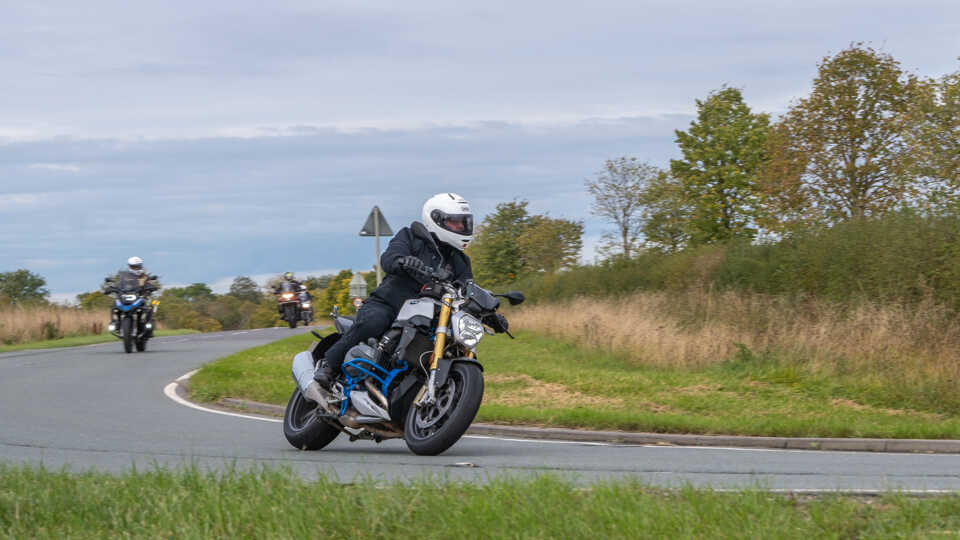
I started off on a couple of Ariels, but by the end of the first 45 minute session I'd ridden the vast majority of the bikes at least once. 45 minutes doesn't sound a lot, but to be fair at the time it was plenty long enough (I remember thinking "we've been riding WAY longer than 45 minutes" - we hadn't). A 15 minute coffee break, then back for a second 45 minutes in the same format. An hour and a half of riding round the carpark was sufficient to satiate your old-bike needs, especially as for many bikes you rarely got out of 1st gear (to be fair, on some bikes that was due to fear of not being able to find 2nd … or 1st again !) and you rarely went above 15-20 mph. The corners were great though, very flowing, and looking back on some of the photos I got more of a lean on than maybe due diligence of someone else's prize 50-80 year old bike with old tyres maybe called for !
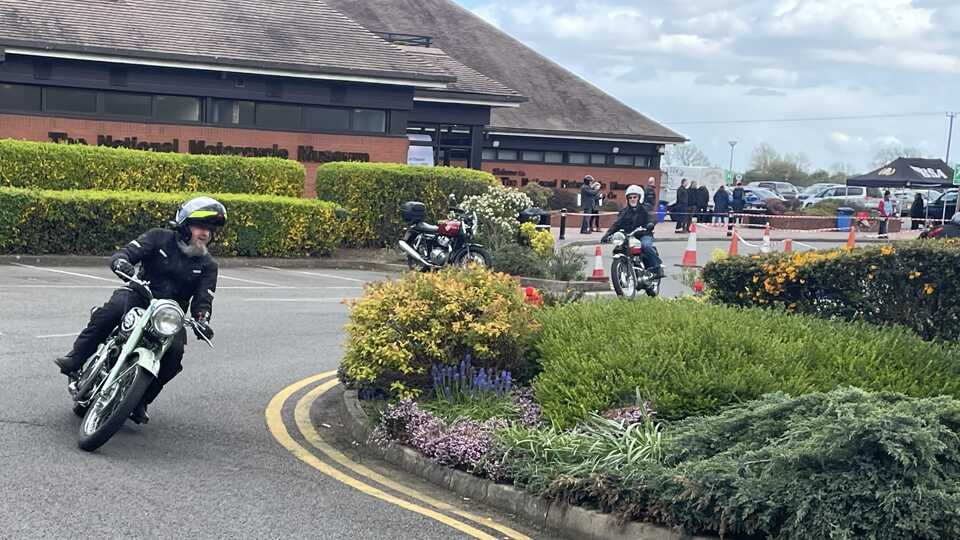
I will take this opportunity to apologise for the textiles I'm wearing - I know, I know, totally not in keeping with the style of bike and not very DGR, but that heavy rain did make an appearance as forecast, particularly just as the event finished and we were all about to head for home. And a soggy M42 it was too.
I'll not apologise for the beard however, which apparently takes on a life of its own when unfettered. Magnificent.
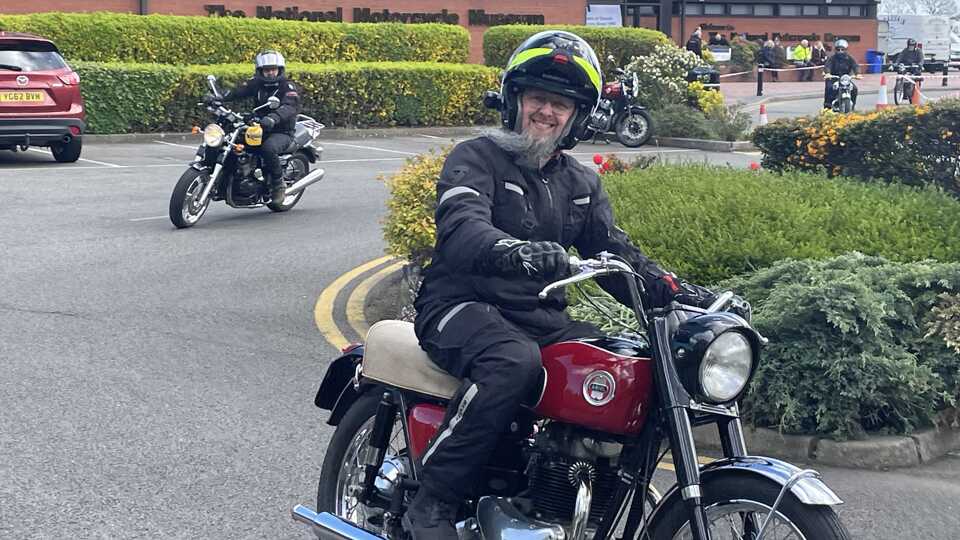
Which bikes did I like then ? I was particularly smitten by the various Ariels - they seemed the most rounded, comfortable, great handling, good exhaust note. With one exception however, the 1962 two-stroke Ariel Arrow - horrible beast ! It perpetually wanted to die (or misfire) unless redlining it; I don't think pottering round a carpark it was in its natural element however, so maybe that's unfair.
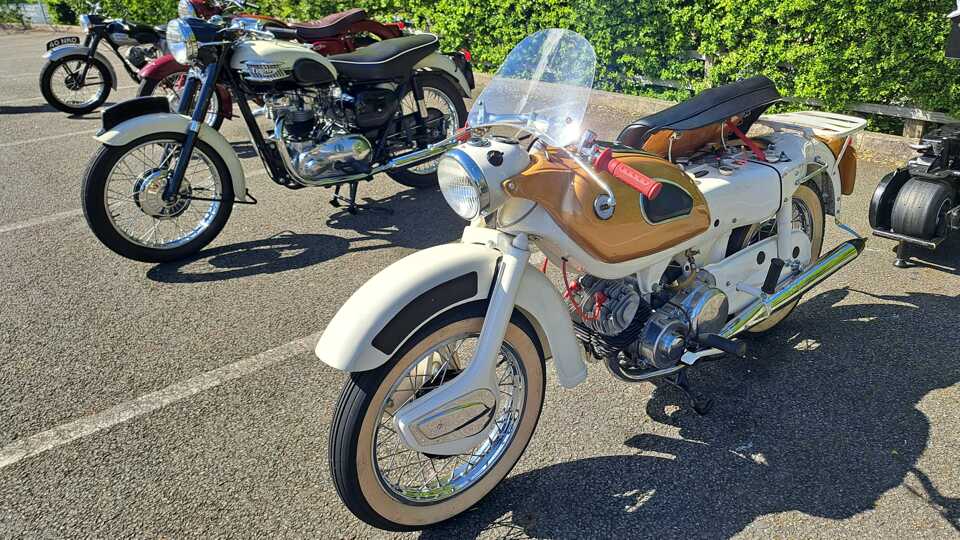
Another in the "love the looks, hate the ride" category was the BSA trials bike - seriously fidgety turn in, digital throttle, and an absolute PITA to start and keep running. Again, this probably wasn't the best place to showcase what that kind of bike can do however.
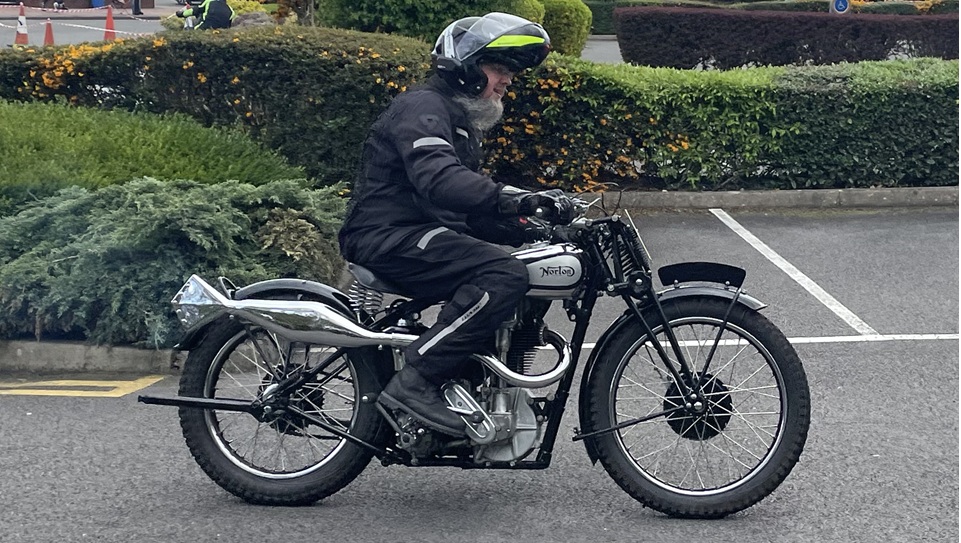
The other BSAs and Triumphs were perfectly nice … the Triumphs (with the exception of the little rattly Tiger Cub) felt the most grown up and "big bike".
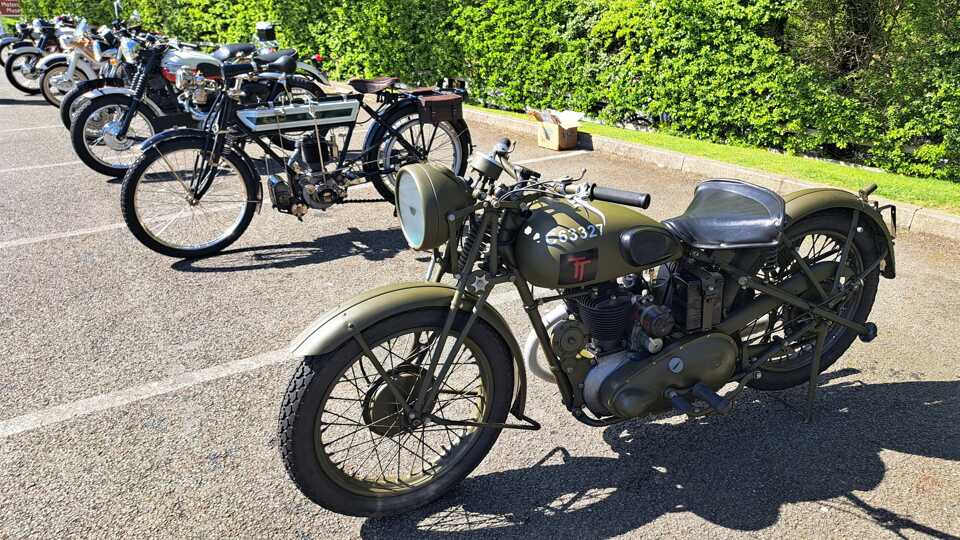
The war-time Triumph was hilarious to ride. Quite "short-coupled", your knees felt up by your chest, but with girder forks up front and a rigid rear end, the large-sprung-but-undamped seat led to you bouncing your way round the course ! Smiles all the way round.
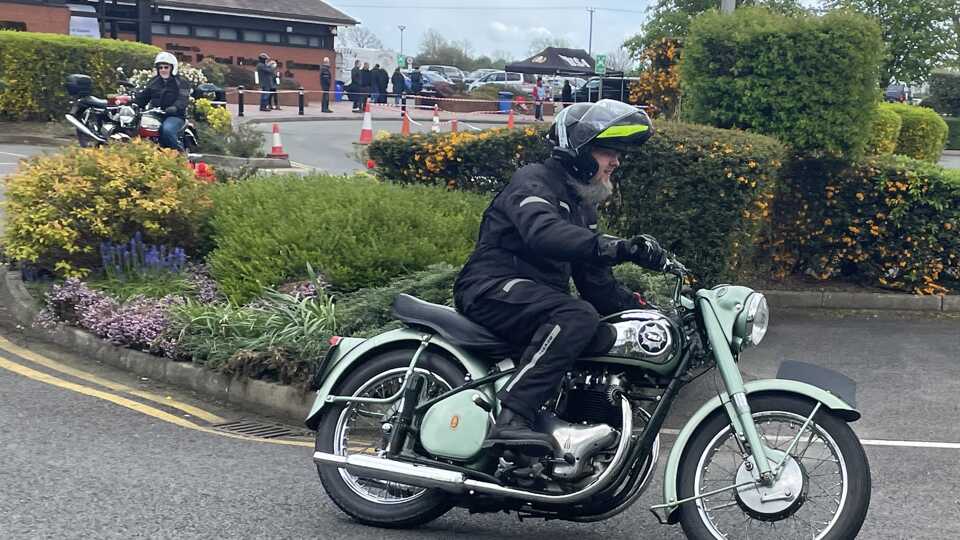
But my absolute favourite was the metallic green 1960's BSA A7SS Shooting Star - great handling, superb exhaust note, very much an old bike you could live with and actually enjoy riding some distance. Must start saving my pennies ...
And did I have a go on that 2004 Triumph ? Yes, I did - briefly. For about 2 laps, and found it less interesting, less fun and poorer handling than many of the much older bikes !
And did I have a ride of the 1914 "The New Comet". The bike with cycle brakes which didn't work, and you had to slow for corners by pulling in the decompression lever ? The bike that you had to pedal to start, with two volunteers pushing ? The one where the throttle was a little chrome lever, one of many random "what the heck does that do" levers ?
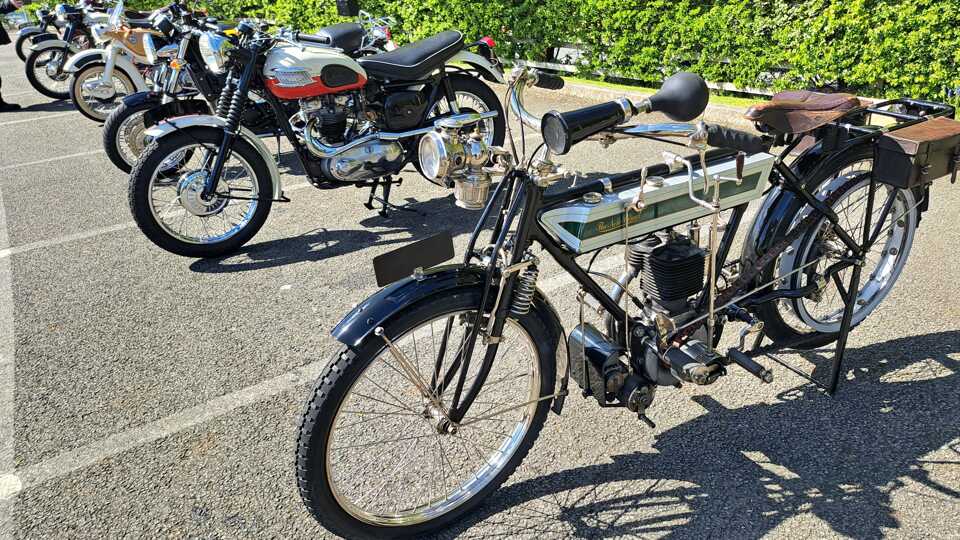
No. I think I'll save that for next time ... maybe I'll see you there ?